
Recent Post

Archive
- August 2026
- February 2025
- January 2025
Tags

Dog in Heat and Male Dog Won't Leave Her Alone? What to Do | Delay Her Spay™
Dexter Blanch
Aug 31, 2026
0 comments
Your female dog is in heat—and suddenly your male dog seems like a completely different animal.
He follows her everywhere.
He whines at the door.
He paces through the house.
He may stop eating normally, become restless, mark more frequently, or constantly try to get into the room where she is staying.
You separate them, and he tries to get back to her.
You put her outside, and he wants outside.
You bring her inside, and he follows her scent.
If you're thinking, “My female dog is in heat and my male dog won't leave her alone—what am I supposed to do?”, you're dealing with one of the strongest natural instincts in dogs.
The solution isn't simply telling your male dog to stop.
You need to manage the environment so the dogs don't have an opportunity to mate.
Here's what every pet parent should know.
Why Is My Male Dog So Obsessed With My Female Dog?
When an unspayed female enters her heat cycle, hormonal changes cause her to produce scent signals that can be extremely attractive to intact male dogs.
Your male isn't simply noticing that something is different.
His reproductive instincts are responding to biological information coming from the female.
That response can be powerful.
You may notice your male dog:
- Following the female constantly
- Sniffing her repeatedly
- Licking areas where she has been
- Whining or crying
- Pacing
- Scratching at doors
- Trying to escape
- Urine marking
- Becoming distracted
- Ignoring normal commands
- Showing less interest in food
- Attempting to mount the female
- Becoming frustrated when separated from her
Some owners interpret this behavior as their dog suddenly becoming disobedient.
That's usually not the best way to think about it.
Your dog's biology is telling him that a potential reproductive opportunity is nearby.
That is precisely why physical management becomes so important.
Can a Male Dog Smell a Female in Heat?
Yes.
Dogs possess an extraordinarily sensitive sense of smell, and scent plays a major role in canine reproduction.
A female in heat produces chemical signals through her urine and reproductive secretions that can attract intact males.
This explains something that surprises many pet parents:
Your male may become interested in your female before you realize she is in heat.
Suddenly persistent behavior from an intact male can therefore be an early clue that your female's reproductive cycle is changing.
Will My Male Dog Calm Down?
Eventually, yes.
But don't rely on your male dog's behavior to determine whether your female is still capable of becoming pregnant.
A female dog's reproductive cycle occurs in stages, and individual dogs vary considerably in timing.
Your male may remain interested for an extended period. His level of interest may also increase or decrease as the female moves through her cycle.
The practical lesson is simple:
Don't assume your female is no longer at risk simply because your male seems calmer.
Continue your pregnancy-prevention precautions until you are confident the heat cycle has ended. If you are uncertain, consult your veterinarian.
Note: Although we haven't done a comprehensive study, some of our pet parents have told us that the male dog will know when the Delay her Spay harness is on your female. When he does, he know he cannot mate with her. You might notice that he is calmer when she is protected.
Can My Female Dog Actually Want to Mate?
Yes.
This is something pet parents sometimes overlook.
During the earlier part of the heat cycle, a female may attract males without accepting mating. As she moves into the receptive portion of her cycle, her behavior can change.
She may begin actively cooperating with the male.
You might notice her:
- Seeking his attention
- Standing rather than moving away
- Moving her tail to the side
- Becoming more interested in getting near him
- Attempting to escape confinement
- Showing increased interest in outdoor scents
This changes the problem considerably.
You are no longer necessarily trying to keep one determined dog away from another.
You may be trying to keep two motivated dogs apart.
That's why prevention needs to rely on physical safeguards rather than obedience alone.
What Should I Do When My Male Won't Leave My Female Alone?
1. Physically Separate the Dogs
This is the most important step.
If the dogs live in the same household, establish separate secure areas.
Don't assume that being on opposite sides of the same room is enough.
Depending on your home, physical separation might involve:
- Separate rooms
- Closed and securely latched doors
- Appropriate crates or enclosures
- Separate outdoor schedules
- Controlled movement through common areas
For particularly persistent dogs, owners may use more than one barrier between them.
The important objective is simple:
The dogs should not have unsupervised physical access to each other.
2. Create a Household Heat-Cycle Plan
Many accidental matings aren't caused by owners intentionally putting the dogs together.
They happen because someone makes a mistake.
A child opens a door.
A visitor doesn't know the female is in heat.
Someone lets both dogs into the backyard.
A gate isn't completely latched.
One dog slips through a doorway while the other is being moved.
If multiple people live in your household, everyone needs to understand the rules.
Consider establishing a simple system:
Who takes the female outside?
Where is the male while she is outside?
Which doors must remain closed?
Who is responsible for checking gates?
A prevention strategy is only as strong as the people following it.
3. Never Leave Them Together “Just for a Minute”
This is one of the most important rules.
Don't assume you will have enough time to intervene.
Don't leave an intact male with a female in heat while you answer the telephone, grab something from another room, or step outside.
An accidental mating doesn't require hours of unsupervised access.
The safest strategy is to prevent the opportunity altogether.
4. Supervise Every Outdoor Trip
Your female shouldn't be left alone in the backyard simply because the property is fenced.
Remember that the reproductive scent attracting your male can potentially attract other intact males as well.
A determined dog may attempt to:
- Jump a fence
- Dig underneath it
- Push through a weak section
- Enter through an unsecured gate
Your female may also become more interested in leaving the property.
During her heat cycle, accompany her outdoors and maintain direct control.
5. Keep Her Leashed Away From Home
This isn't the time for off-leash walks.
Even a normally obedient dog can behave differently when reproductive instincts are involved.
Use a secure leash and consider choosing walking times and locations where encounters with other dogs are less likely.
If an unfamiliar off-leash dog approaches, create distance rather than assuming the dogs will simply greet each other.
6. Avoid Dog Parks and Dog Daycare
A female in heat generally shouldn't visit dog parks or uncontrolled group-dog environments.
You may not know which males are intact.
You also can't control how another dog will respond to your female's scent.
Temporarily avoiding these environments removes an unnecessary risk.
7. Give Your Male Dog Something Else to Do
Separation prevents mating, but it doesn't necessarily eliminate your male dog's frustration.
Exercise, enrichment, and structured activities may help redirect some of his energy.
Depending on the individual dog, consider:
- Longer supervised walks away from the female
- Food puzzles
- Training exercises
- Interactive toys
- Scent games unrelated to the female
- Individual play sessions
These activities won't eliminate reproductive instinct, but they may make the separation period easier to manage.
If your male becomes extremely distressed, stops eating, injures himself trying to reach the female, or develops other concerning behaviors, contact your veterinarian.
Will a Dog Diaper Keep My Male From Mating With Her?
This deserves special attention because it's an easy assumption to make.
A female is in heat.
She's wearing a diaper.
Her reproductive area appears covered.
Problem solved?
Not necessarily.
Most conventional dog diapers are designed primarily to absorb discharge and help keep your home clean.
They are generally not designed as anti-breeding devices.
A determined dog may potentially move, dislodge, damage, or work around a soft garment.
That doesn't mean dog diapers are useless.
They can be extremely helpful for their intended purpose: managing discharge and keeping your home cleaner.
But managing the mess and preventing mating are two different jobs.
If pregnancy prevention is the objective, don't treat an ordinary dog diaper as your only physical safeguard.
What About a Physical Anti-Breeding Barrier?
This is where an additional physical barrier can become another part of a layered prevention strategy.
Think about pregnancy prevention this way:
Secure Separation + Direct Supervision + Controlled Environment + Additional Physical Barrier
No responsible pregnancy-prevention strategy should depend entirely upon one product.
But adding a physical barrier specifically designed to help prevent mating can provide another safeguard if human error or an unexpected encounter occurs.
That's particularly valuable in households containing both intact male and female dogs.
What If My Male Dog Keeps Crying or Whining?
Whining and pacing can be difficult for both the dog and the owner.
Remember that your male doesn't understand why he can detect a female in heat but isn't permitted to reach her.
Don't punish him simply for responding to reproductive scent.
Instead, focus on management.
Increase distance between the dogs where practical.
Provide exercise and enrichment.
Reduce unnecessary exposure to the female.
Maintain secure separation.
If the behavior becomes extreme or you're concerned about your dog's welfare, consult your veterinarian.
Should I Send One Dog Somewhere Else?
For some households, temporary relocation of one dog may be worth discussing.
However, this requires careful planning.
Moving the female doesn't automatically eliminate risk because she could encounter other intact males at the new location.
Moving the male may reduce his exposure to her scent, but the alternate environment must also be safe and appropriate.
If you're considering boarding or temporarily relocating either dog, make certain the person or facility understands that an intact female is in heat or that the male is being separated from one.
What If They Accidentally Get Together?
If an intact male gains access to your female, separate them before mating if you can do so safely.
However, if the dogs have already mated and become physically “tied,” do not forcibly pull them apart.
A tie is a normal part of canine mating and can last for a period of time.
Forcing the dogs apart can cause injury.
Keep the environment calm and prevent either dog from struggling as much as reasonably possible.
Then contact your veterinarian promptly for guidance.
Do not assume that pregnancy definitely occurred.
But don't assume that a brief encounter means pregnancy is impossible either.
Your veterinarian can discuss appropriate next steps based on what happened.
How Long Do I Need to Keep My Male and Female Apart?
Unfortunately, there isn't a universal number of days that guarantees safety for every dog.
The canine reproductive cycle varies.
This is why simply counting days can create false confidence.
Rather than asking:
“What is the first safe day?”
A better question is:
“Has her heat cycle completely ended?”
Until you're confident that it has, continue your precautions.
If determining your dog's reproductive stage is particularly important, speak with your veterinarian about appropriate evaluation or testing.
What If I'm Waiting to Spay My Female?
Some owners are managing this situation because their female hasn't been spayed yet.
Your veterinarian may recommend a particular timing based on factors specific to your dog, including her age, breed, size, health, and development.
If your female experiences a heat cycle before her planned spay procedure, you'll need a pregnancy-prevention strategy.
That strategy should be established before the heat cycle begins whenever possible.
Have your separation plan ready.
Inspect the yard.
Decide who will supervise outdoor trips.
Have any protective equipment you intend to use available.
And make sure everyone in the household understands what needs to happen.
Frequently Asked Questions
Why won't my male dog leave my female dog alone?
An intact male may respond strongly to the scent and hormonal signals produced by a female in heat. His behavior may include following, sniffing, whining, pacing, marking, attempting to escape, or trying to mate.
How do I calm a male dog when a female is in heat?
Increase physical separation, reduce his exposure to the female, provide exercise and enrichment, and maintain a structured routine. Contact your veterinarian if his distress becomes severe.
Can I keep my male and female dogs in the same room?
If your objective is preventing pregnancy, allowing an intact male physical access to a female in heat creates unnecessary risk. Secure physical separation is safer.
Will a diaper prevent my male from mating with her?
Conventional dog diapers are generally intended primarily to manage discharge, not to prevent mating. Don't rely on a standard diaper as your only pregnancy-prevention measure.
Can dogs mate quickly?
Yes. Accidental mating can happen much faster than owners expect, which is why preventing physical access is more reliable than planning to intervene.
Can my female get pregnant after mating once?
Yes. A single successful mating during the fertile period can potentially result in pregnancy.
What should I do if my dogs become tied?
Do not forcibly pull them apart. Keep the environment calm and contact your veterinarian for guidance.
When can my male and female be together again?
Wait until the female's heat cycle has completely ended. Because timing varies between dogs, consult your veterinarian if you're uncertain.
Your Male Isn't Being Bad—He's Responding to Biology
When your male dog won't leave your female in heat alone, it can be exhausting.
But understanding the reason behind his behavior changes how you should approach the problem.
Don't rely on punishment.
Don't rely on obedience alone.
Don't assume a diaper will prevent mating.
And don't assume you'll always have enough time to intervene.
Instead, manage the situation physically.
Separate the dogs.
Supervise your female.
Secure your property.
Control outdoor encounters.
And consider adding another physical layer of protection.
The objective isn't to fight your dogs' natural reproductive instincts.
It's to prevent those instincts from creating an opportunity for an accidental breeding.
Add Another Layer of Protection With Delay Her Spay™
When a female dog is in heat and a determined male is nearby, relying on a conventional dog diaper may not provide the type of physical protection you're looking for.
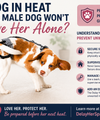
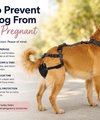
The Delay Her Spay™ Harness System was designed specifically to provide an additional physical barrier to help prevent unwanted mating.
Unlike an ordinary dog diaper designed primarily to manage discharge, the patented Delay Her Spay™ anti-breeding harness system is designed around a different purpose: helping pet parents protect an intact female against unwanted breeding while still allowing normal urination and defecation when properly fitted.
Delay Her Spay™ should be part of a broader heat-cycle management strategy that includes secure separation, direct supervision, controlled outdoor activity, and appropriate veterinary care.
🐾 Love her. Protect her. Be prepared before her next heat.
Learn more about Delay Her Spay™ at DelayHerSpay.com.